
Books
Self-Published

Blame It On Socrates (2025)
This is the story of Patrick Dolan, a middle-aged college professor
who teaches philosophy at a small mid-western college who cannot seem
to shake his past no matter how hard he tries. Helping the good
professor put his past behind him is the campus jack-of-all-trades,
Hap Williams, Sarah Goldstein, a fellow student radical who is on her
death bed, and a neurotic dog called Socrates (the other Socrates) who
likes to steal and bury his mail. Follow him at Simpson College for a
semester where a mishap over a broken library copier, a letter from a
dead friend, a student protest inspired by an ancient Greek
philosopher and a borrowed shovel unleashes a series of events related
to his attempt to make sense of it all.
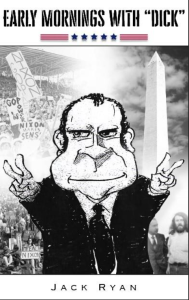
Early Mornings with Dick (2026)
Set against the charged backdrop of late-1960s Washington, this novel follows Ryan Murphy, a first-year law student at Georgetown University whose life veers sharply off course after a chance, early-morning encounter with President Richard Milhous Nixon on the steps of the Lincoln Memorial. What begins as an improbable conversation between a young man searching for purpose and a president burdened by power soon evolves into a series of clandestine meetings—quiet exchanges that blur the line between mentorship, manipulation, and moral reckoning.
As Murphy balances the rigors of law school with the weight of national secrets, the novel becomes a meditation on service, ambition, and the cost of proximity to power. Their conversations range from constitutional ideals and public duty to the anxieties of youth in an America fractured by Vietnam, protest, and generational distrust. Yet history presses in. Watergate looms. Intelligence agencies take notice. And Murphy—law student turned reluctant sleuth—must decide how close is too close when institutions meant to protect democracy begin to corrode from within.
In the tradition of Advise and Consent, the novel captures the intimate mechanics of Washington politics, while its youthful perspective recalls the moral awakening found in The Manchurian Candidate—where innocence collides with conspiracy. Readers drawn to the ethical tension and investigative pulse of All the President’s Men will recognize the creeping unease of a system unraveling, seen here not from the newsroom, but from the classroom.
At its heart, this is a coming-of-age story set inside the corridors of power. It asks what it means to come of age in a moment when belief in institutions is faltering, when history feels both inevitable and unfinished, and when the choices of the young may determine whether the republic’s ideals endure or erode.
Smart, suspenseful, and quietly provocative, this novel reminds readers that history is not only shaped by presidents and scandals—but by the young people who find themselves standing close enough to ask hard questions, and brave enough to listen to the answers.
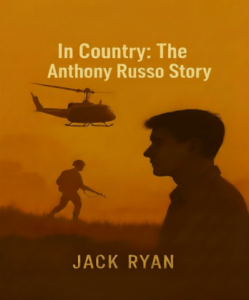
In Country: The Anthony Russo Story (2027)
Set against the turbulent backdrop of 1968, In Country follows Anthony Russo, a recent college graduate whose dreams of becoming a journalist are abruptly derailed when he’s drafted into the U.S. Army. Facing a life-altering decision, Russo weighs four grim options: report for duty and risk death in Vietnam, join the National Guard and hope to avoid combat, manipulate the system to secure a 4F deferment, or flee to Canada as a draft dodger. In search of guidance, he turns to a trio of conflicting voices—his uncle Alfonse, a WWII veteran with mob ties and a shady draft-evasion scheme; a former college professor active in the anti-war movement; and a high school friend recently returned from the war with haunting stories of survival. Through Russo’s moral struggle, the novel captures the impossible choices facing a generation of young American men during one of the most divisive eras in U.S. history.
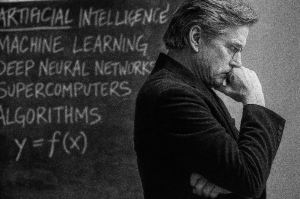
2034: Playing with Fire (2028)
In “2034: Playing with Fire,” Alfred Prescott Edwards, an academic researcher and computer scientist laments his role in the development of artificial neural networks and artificial intelligence (AI). He expresses deep concern about the consequences of these technological advancements, fearing that they have unleashed a powerful and potentially dangerous force. Edwards takes the reader through a detailed account of how innovations in computer science and technology over the past three decades have transformed various fields, including information sharing, government, finance, education, medicine, and military affairs.
The narrative is structured around Edwards’ remorse and introspection, as he grapples with the ethical and societal implications of AI. His reflections serve as a cautionary tale, urging readers to consider the potential risks and challenges posed by AI. The book raises important questions about the ability to control and manage the impact of AI, prompting readers to ponder whether it is possible to “put the genie back in the bottle” before it is too late.
The story is set in a future where AI has become deeply integrated into everyday life, highlighting both the benefits and the potential dangers of such technology. Through Edwards’ journey, the book explores various perspectives on AI, including its transformative power and the ethical dilemmas it presents. By examining the timeline of technological advancements, the narrative provides a comprehensive overview of the evolution of AI and its far-reaching effects on society.

 English